Section 2303 of the Arts and Cultural Affairs Law
All images: Ansh Sirohi
Prologue
Section 377A was introduced to Singapore'south penal code in the center of 1938. It reads: "Any male person who, in public or private, commits, or abets the commission of, or procures or attempts to procure the committee by any male person of, any act of gross indecency with another male."
Simply put, 377A criminalises sex activity between two consenting male adults. Information technology is generally believed that the police derives from the British government'south want to 'safeguard' public morality past prohibiting homosexual action in the Straits Settlements.
Nonetheless, documents recently declassified by the British authorities reveal that this is not the instance. 377A was, in fact, motivated by a scandal in which prominent white European men were discovered to have slept with Asian male person prostitutes. This drove the Straits Settlement government into a panic because information technology saw the scandal—of the white man succumbing to the native boy—as a threat to its colonial rule.
Based on historical and archival research, this article retells the circumstances that led to the enactment of 377A in 1938.
Sir Thomas Shenton, Governor of the Straits Settlements, is in a wee bit of a pickle. All considering of an innocent-looking book that his police force had seized from a Chinese male person prostitute.[1]
He paces effectually his table several times without letting the book out of his sight. And then, sighing securely, he picks it up, for what must accept been the hundredth time that day. He does not like what he sees in the book.
Names he recognises flit beyond his eyes. Prominent Europeans in his government; in the civil service; in colonial social club.
Prominent white European men .
It is not so much the issue of homosexuality, or even prostitution, that makes Shenton so anxious to remove these men from his government.
It is the fact that these are European men who are consorting with Asian male prostitutes.
What of the hierarchy of races? How can the white man merits legitimacy and dominion over his colonial subjects if he is sleeping with native boys and—possibly—existence penetrated past them? What'south next—throwing open the doors of Tanglin Club to the natives? [two]
Shenton shudders.
It is a shudder that tells him a new law needs to exist enacted—not to preserve public morality, per se—merely to prevent European men from debasing themselves, and the colonial government, past sleeping with Asian male prostitutes.
Or, if not a new law, an amendment to an existing ane: Section 377A.
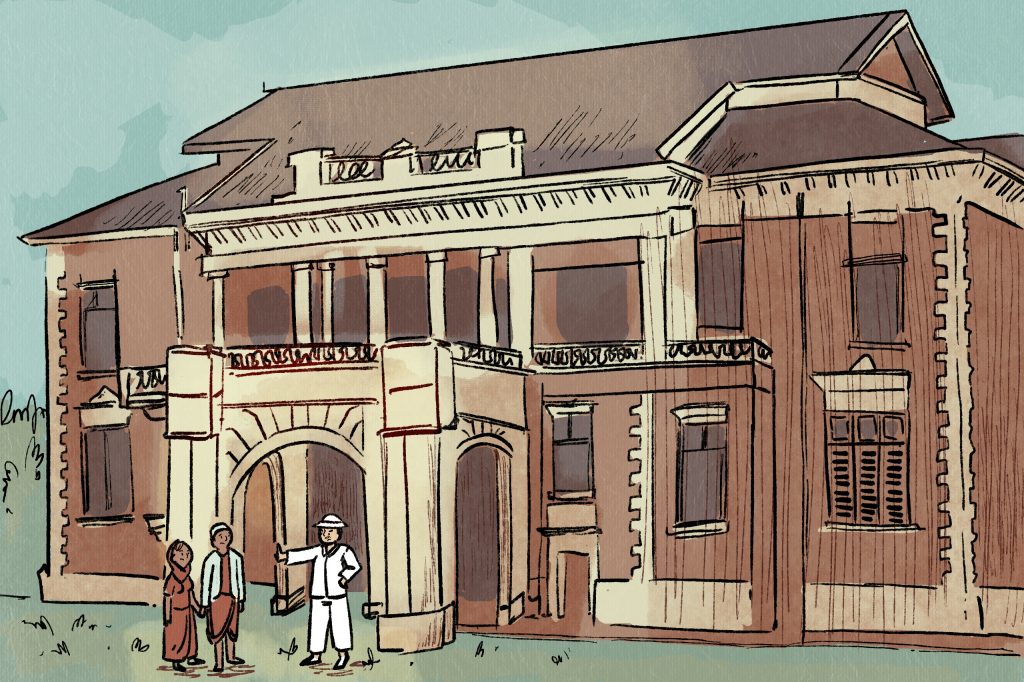
Endemic sexual deviances
Shenton knows he has to be strategic for his proposed law to laissez passer. Banning homosexual activeness on moral grounds might backlash because morality, in the Asiatic world, has a dissimilar meaning to the natives compared to refined Europeans like himself.
He recalls how, earlier departing for Singapore, he was instructed to read a 1896 dispatch from the Straits Settlements Association in London. Information technology described the predilection of local men for "unnatural vice". [3]
Frowning at this memory, Shenton puzzles at how what is "unnatural" can vary so much in different parts of the world, at different periods of time, and so as to appear arbitrary.
Perhaps information technology is because of the harsh local climate, or the uncivilised culture of the Asiatics, but homosexuality and other sexual deviances are owned—almost natural and expected—in the Straits Settlements. [iv]
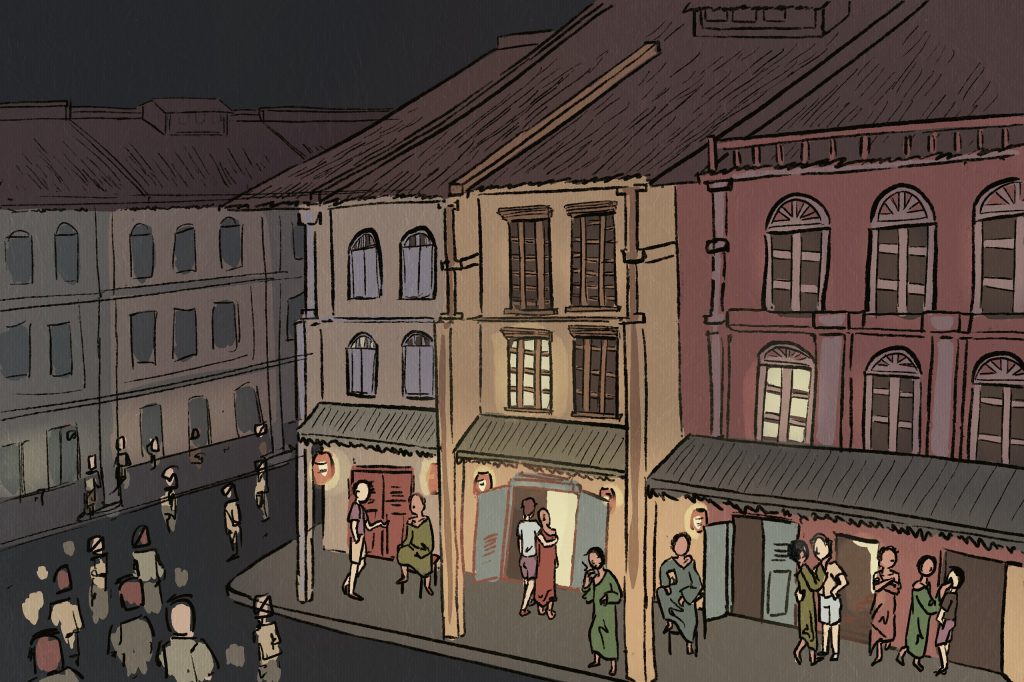
Equally Shenton discovers, even prior to his arrival, Singapore had six flourishing male brothels, staffed by 12 male prostitutes. [5] Indeed, the acceptability of homosexuality in the colonies was the defence mounted by several Europeans when they were caught in the arms of native men.
The first perpetrator who comes to Shenton's mind is Mr. H. Gerhold—the Assistant Commissioner in the Federated States Police Force, no less!
Not but did Gerhold make information technology a addiction to seek the company of young Malays, including members of the force, he likewise admitted in a Argument of Fact addressed to the Governor of the Federated Malay States, that he had "experimented" many times with several Asian men. Among them are a Javanese known as Jusari, and a frequent visitor to his bungalow named Hassan.
An offence that's difficult to prove
Protesting his innocence, Gerhold, in a alphabetic character dated 6th March 1938 and addressed to the Loftier Commissioner of the Federated Malay States, writes that "in this country … this vice is peculiarly prevalent amongst both Europeans and Asiatics".
Moreover, "information technology is not regarded with the same disapproval accorded to it in western countries" because "the Asiatic… regards this vice as no less natural than womanizing and conveying no greater stigma".
Shenton is not convinced. Gerhold, later on all, is a white European man, not an Asiatic. He ought to live past different cultural values than the natives. Perhaps, Shenton muses, a new law volition remind him of where he comes from.
More troubling to Shenton is how these officials are so obstinate in denying guilt. Well, Shenton admits to himself, they are technically right. In the optics of the law, they have committed no criminal offense.
Sure, sodomy is already a penal code offence. But unless Shenton catches them in the act—penis in anus—it is near impossible to evidence that something illegal had taken place.
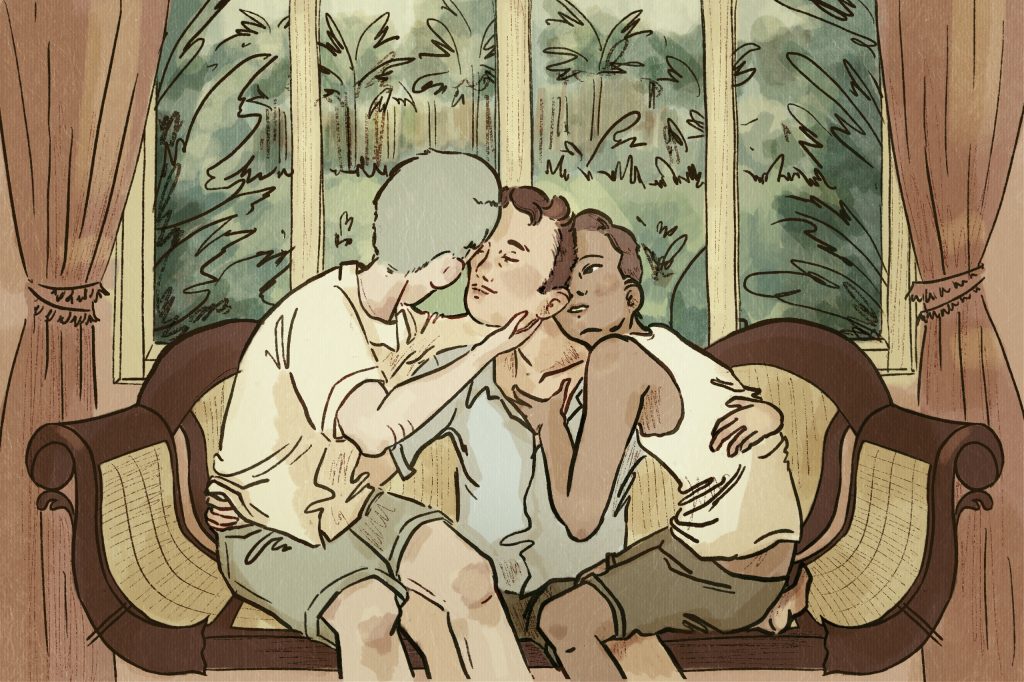
"His penis was not erect"
Such is the example with Mr Reeves, a member of the Malayan Civil Service, whom the Executive Council Committee suspected had been frolicking with Asian male prostitutes. Upon hearing this, Shenton, of course, recommended removing Reeves from the Service.
Imagine if the full general population were to discover out that a white human had succumbed to the allure of a native! It would expose Europeans to blackmail and jeopardise the respect the natives have of the colonial government.
Unfortunately, the Secretary of State did not approve Shenton's recommendation considering no accuse against Reeves could exist proved.
Furthermore, the regime could not remove Reeves on grounds of inefficiency—the only legitimate avenue left for dismissal —because Shenton, honest every bit he is, had to acknowledge that Reeves is yet performing his duties adequately, despite this major flaw in his grapheme.
Worse is the state of affairs with Mr. H Moses, a European Warder in the Straits Settlements prison. Shenton tries not to moving-picture show the scene—but fails because of how absorbing the image is.
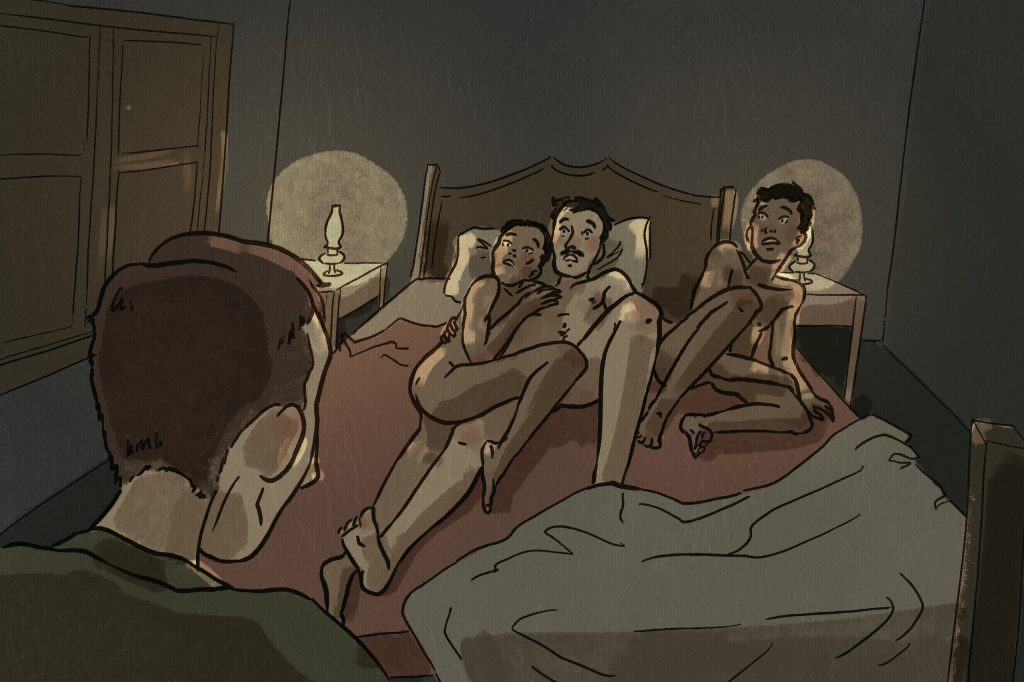
A Japanese Hotel in Prinsep Street. Moses, naked, sprawled on the middle of the bed. An Asian boy sitting on Moses'due south tum, his back to Moses's face. Another lying by Moses, stroking his face. The police officers who caught Moses red-handed stand frozen at the door, mouth agape.
No human activity of "carnal intercourse against the lodge of nature"—as stated in Section 377—had happened here, Moses argued after his arrest.
They were simply three men enjoying each other's company, albeit sans clothing.
Moses' defence? His penis was non erect.
Whatever male person who, in public or private, commits, or is a party to the commission of, or procures, or attempts to procure the committee by any male person of, any act of gross indecency with another male, shall be guilty of a misdemeanour…
The original text of the Labouchere Subpoena, passed in the United kingdom in 1885
The Labouchere Subpoena
These unsatisfactory scenarios made Shenton realise that new procedures have to be adopted when dealing with future cases of this nature.
Mulling over the matter of Moses, Shenton has an epiphany: he could simply infringe the wording of the Labouchere Subpoena, a constabulary criminalising homosexual activity, that was passed in England and Wales in 1885.
Instead of stipulating "carnal intercourse", the Labouchere Amendment outlawed "any act of gross indecency" between two male persons.
The fact that Section 377A will exist enacted a whole 53 years after the Labouchere Subpoena is of no concern to Shenton.
Unlike the latter, which was indeed a barometer of public morality, Section 377A will be used more than as a tool to rid the colonial government and lodge of European men who disgraced their own kind by consorting with native male person prostitutes.
Therefore, Shenton assures himself, the gap between the enactment of the Labouchere Subpoena and Section 377A in the Straits Settlements volition non invite whatever accusations of the colonial government having lax public moral standards.
After all, the policing of homosexual activity between ii men, as is clear to anyone in the government at this point of time, is not the reason for 377A'southward being.
Section 377A passes
Section 377A passes in June 1938 without fanfare, sealing the fate of many European men.
Shenton is not a heartless man, all the same. Or, to be more than accurate, he is not heartless towards the prototype of the British colonial service, and the reputation of his race.
Thoughtful every bit he is, Shenton outset muzzles the media so that not one detail of this scandal leaks out to the public.
Second, he decrees that any European plant guilty nether the new law—which, in whatever case, will not apply retroactively—exist given the option of resigning and leaving Malaya.
Crucially, the option must be given before criminal proceedings are instituted, Shenton is careful to stress, in a memo entitled "The Malayan 'sexual pervasion' cases" that he writes after 377A had been enacted.
This is an important point. In some cases, the prosecution may be undesirable and not in the public interest.
But remember, for example, of the furore that will erupt in the colonies should the masses detect out near the curious instance of the bishop's son, or of the two missionaries. Then Shenton realises that, no, he does non desire to recollect nigh it.
Section 377A, then, is just a last resort. To ensure this point is hammered dwelling house, Shenton proposes that he should take the power to order an inquiry under Colonial Regulations in lieu of prosecution. In other words, no white man should be prosecuted nether Department 377A without his explicit consent.
The respectability of the European race, and the legitimacy of its governance, are paramount. All other issues involved are simply collateral damage.
Any male person who, in public or private, commits, or abets the commission of, or procures or attempts to procure the commission by whatsoever male of, whatever act of gross indecency with another male person, shall exist punished with imprisonment for a term which may extend to 2 years.
The full entry on Section 377A, introduced to Singapore's Penal Code in 1938
Repercussions
Equally members of the European customs, both Gerhold and Moses are, indeed, recipients of the colonial regime's abstinence.
Not just is Gerhold non fired from colonial service, he is sent to Palestine to farther his political career, "in spite of his lapses in Malaya", as an official colonial report euphemistically reported. Additionally, the colonial government has been firmly instructed not to inform the Palestinian government well-nigh Gerhold's Malayan "past".
Moses, on the other hand, opts for a quiet resignation, leaving Singapore for Brisbane on 18 March 1938.
The milk of mercy continues to menstruation for Europeans subsequently Gerhold and Moses. Even later Section 377A was enacted, no European human is prosecuted nether it for dotty behave with another European man .
Just inter-racial sexual relationships lubricated by money, or non-consensual and exploitative sexual relationships between two Asian men, registered on its radar. The natural sexual habits of the natives, after all, are not the intended target of the subpoena.
Shenton is pleased: since its introduction, Section 377A has indeed preserved the public wholesomeness of the white man, fulfilling the main reason for its existence.
References
[1] Victor Purcell, The Memoirs of a Malayan Official, p. 250. Ronald Hyam, Empire and Sexuality: The British Experience, p. 109.
[ii] Membership in Tanglin Club was restricted to white Europeans. It was only in 1951 that Asian guests were allowed in; even then, they were only welcome once a month after seven PM. J. A. Mangan, Europe, Sport, World: Shaping Global Societies, p. 88.
[3] "The Straits and the C.D.O", The Straits Times, xx December 1897.
[iv] Robert Aldrich, Colonialism and Homosexuality, p. v.
[5] Ronald Hyam, Empire and Sexuality: The British Experience, p. 145.
If you haven't already, follow RICE on Instagram , TikTok , Facebook , and Telegram . If you take a lead for a story, feedback on our piece of work, or just want to say hi, you tin can also email united states at community@ricemedia.co
hartfieldtaknottem.blogspot.com
Source: https://www.ricemedia.co/current-affairs-features-history-377a-racism/
0 Response to "Section 2303 of the Arts and Cultural Affairs Law"
ارسال یک نظر